Saturday, 2 March 2013

The Black Eagle has landed

This is a sequence of shots of a Verreaux's (Black) Eagle I was fortunate to view up close during yesterday's transect. He/she has been hanging around for a few days now. I'm always torn between wanting to not disturb these majestic creatures, and wanting to shout and chase them - to teach them to fear humans. Their ranges are large and easily extend beyond protected areas and over sheep and goat ranches nearby - where they are not viewed with a friendly eye, considered to be predators of lambs and kids. Sadly, a dollar is still worth more than exquisite beauty. Perhaps somewhat selfishly I left this regal bird unmolested.

To find out more about Black Eagle Research in South Africa, visit the Black Eagle Project blog... http://blackeagleproject.blogspot.com


4x4 rolls off a hill


About the most exciting event that occurred during the February survey was just after finishing a transect at Kouga Wilderness. I had arrived the previous day in order to camp and get to the transect start at a reasonable time – as this transect is the furthest from Blue Hill – over 130km away by road, 30km of which is down the scenically spectacular Kouga Canyon. In a straight line, Kouga Wilderness is only but only 50km from Blue Hill as the sunbird flies. The campsite is under old oak trees, and I was the only person there, until the following day when I was packing up and a young man in his early twenties dropped of his kit at a small caravan.

To do the survey I had taken my bike up a 4x4 track leading into the mountains. On the way out the owners, Nico and his wife, asked me why I had not driven up in the Jimney. While my reasons were many, I replied that at the moment my tyres were a bit worn and I was having them changed the following week.

Having just said that, we all fell silent as from the hills a thumping noise grabbed our attention. We looked around to see if something nearby was falling over, and then realised the noise was echoing down the valley. Then we saw from the 4x4 track that ascends the steep hill opposite a white bakkie (pickup) rolling down the hill.

“It's not that young lad, o gids, o yinna!” cried Nico's wife

Of course it could only be – there was no one else around. I was torn between starting to run towards the tumbling vehicle, or running for my camera. After an eternal three more seconds we heaved a collective sigh of relief as we saw the young lad (Hennie) running down the zig-zag 4x4 track. The 8 month old Toyota finally came to rest against a giant Aloe ferox.

After some time spent calming Hennie down, it transpired that on the ascent he had occurred a puncture. He had changed the flat tire, and as he was fastening the last wheel nut, the hand-brake gave way and the bakkie immediately obeyed the laws of gravity. He was of course very lucky not to get caught in the way of the run-away vehicle.

Nico's comment to Hennie: “You have the honour of being the first vehicle to roll of that 4x4 track”

Lesson learned for the day – always chock your tires with a rock when stopped on a steep slope!


A view of Kouga Wilderness and the the 4x4 track from which the bakkie rolled.


Counting birds out and about

This summer has been one best described as unpredictable. Temperatures have ranged from 12 degrees on some days, to 35 and over on others. One never knows what to expect, and planning ones day relies a lot on checking weather reports. Even those don’t always get it right. One day looked was forecast to be windy and good for nothing. On waking up too late to change plans the weather was perfect for ringing. Still, there are things to do on the laptop, and time has been spent creating the PhD version of my book and making changes to a manuscript on dietary patterns of parrots of the Peruvian Amazon.

 The nice thing about doing point transects to count birds now is a lot of the baseline data was already collected during the first round of transects, so they can now be done a lot more quickly without too much checking of the gps to make sure I’m walking in a straight line for far enough. So transects that were hard the first time, like going up Antoniesberg, heading over Naartjieskloofberg, and cycling up the Kammanassie were a bit easier this month. During thes hikes or ‘bhikes’ I continue to look for birds with rings, but resightings have been very few. So, late January I placed some camera traps on flowering Protea repens around Blue Hill to see if they would serve as extra ‘eyes’.

 The results have been encouraging. While there are many blank shots taken simply when the wind blows the Protea bushes, many photos have recorded birds, and a few of these have had rings. The problem is I don’t have enough cameras, and used most of my research budget this month to busy an additional 5 cameras – not cheap at close to R3000 each. But they are generating a wealth of data, especially the short video clips which show how the birds are foraging on the Proteas. They may well be useful yet in determining how the birds use the landscape.

Cape Sugarbird takes flight

Spurwing Goose take-off sequence

Cape Sugarbird on a Protea mundii, Prince Alfred's Pass

Rufous-breasted Sparrowhawk
Awesome colors of the Fynbos - Prince Alfred's Pass


Thursday, 28 February 2013

How we are changing the climate, and climate is changing the world we live in


The following graphic was created by learnstuff.com. It paints a dramatic
picture of climate change, and our role in it. What the consequences
will be remain a matter of educated speculation, and will depend on
where one is on the planet. Polar regions are already experiencing
much higher temperatures compared to the historical record, while the
impact around tropical regions may be buffered for a while. Either
way, its good to remind oneself of the potential consequences, and to
think about ones behaviour, consumption patterns (of food and goods)
and goad ourselves into trying to make a difference – for the future
of our children and all the other residents of our beautiful planet.


Climate-Change

Wednesday, 13 February 2013

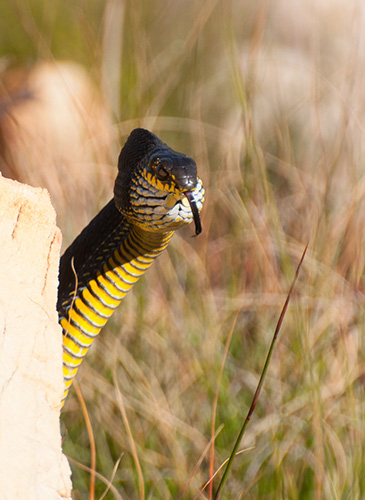
Beware the beautiful Boomslang!


It was transect time again today; and my destination was the Blue Hill boundary with the Baviaanskloof on the ridge of the Kouga mountains. This is one of my favourite routes as it is high – over 1400m for most of it, with views north to the Swartberg, west to the Kammanassie, and south to the Tsitsikamma mountains and there is always something to see. Its just usually not a snake, and especially not a boomslang as most of the vegetation up there has just turned one year old and, well, there are just no trees anywhere. Probably haven't been for many years!

It was a hot day. In fact, my first snake of the day was an unidentified colubrid hiding in the grass that I couldn't get a good photo of. But then as per usual I was distracted by birds or simply trying to find my way up the mountain slope over loose rocks and charred skeletal remains of proteas and the thought of snakes left my mind.

So the dry rasping and flash of yellow glimpsed out of the corner of my eye caught me by surprise, and I had to take a step back in a moment of nervous panic as the boomslang lifted itself off the ground like a cobra, only meters from me. I stood entranced as it swayed from side to side. It was almost as if it was the snake charmer and I was the snake. The big eyes, puffed up neck, darting tongue were mesmerising. Then I remembered my camera in my backpack and I managed these photos of its warning dance before it took shelter under a rock.

With these bright colours, it has to be a male. It was probably 1.5 meters long. Bites are rare – but with hemotoxic venom that stops the blood clotting and can result in internal bleeding, one doesn't want to get bitten as monovalent antivenom is hard to come by and treatment may involve total blood transfusions.


Related Posts Plugin for WordPress, Blogger...