Friday, 8 March 2013

Camdeboo National Park


Camdeboo National Park (formerly the Karoo Nature Reserve) is all about the scenery and the birds. Most of the mammals on the parks checklist can be seen elsewhere, and only the Buffalo represents the big 5. The park is wrapped around the Karoo town of Graaf Reinet.

We arrived in Graaf Reinet after visiting the charming town of Nieu Bethesda, which is undergoing an artistic revival and has transformed from a back-end-of nowhere ghost-town to to a cultural and paleo-historical centre, most of this thanks to the amazing backyard of Miss Helen's Owl House. Best described as a heart-broken eccentric, this dame gave meaning to her life by creating a fantasy world of stone figures from cement and broken glass, before finally ending her life when her eye-sight started to fail. As the centre is not really for childen (due to large carpets of broken glass in some sections), I was put on guard duty outside with Elena, while Anja documented the figurines in the backyard.

I very much enjoyed the subsequent visit to the Kitching Dinosaur Museum, which included the usual educational panels accompanied by unpronounceable dinosaur names, but also a walk into the nearby river bed which is made of rock over 250 millions years old – in which can be seen fossils of the creatures that inhabited the earth back then.

We then turned our backs to Compassberg (the highest free standing mountain in the Eastern Cape) and headed to Graaf Reinet, where we arrived in a bit of a wind-storm that was showering the town, well, with litter. Not too nice. While the town is described in SANParks literature as “..a jewel within the bend of the Sunday's River” there has obviously been a burglary lately and someone's made off with the treasure. The truth is that the town is simply becoming swamped by a growing population, with few employment opportunities.

While there are many accommodation options in the town, including a Municipal campsite, we headed for the 'rustic' Nqweba campsite of the park itself. The facilities are modern, and include a kitchen and new bathrooms, and the sites are private, but better suited to caravans than tents. However, the sounds of nature have a bit of a job competing with the sounds of the nearby N9 and the very busy local airstrip. One may well sleep more peacefully in the town itself, and since the park is wrapped around the town, one would be centrally based too.

After setting up our tent on arrival we headed out for a late afternoon explore of the 'game-viewing section'. Our first stop was the bird hide, which to our disappointment we found offered almost no view as the record high levels of the Nqweba dam combined with the eutrophic waters of they Sunday's River which feeds it have created ideal growing conditions for Phragmites reeds. These now form a wall around the hide, although about a 25m section has been cleared by the parks to create a bit of a view. Several other viewpoints around the dam suffer the same condition. However, the one that does offer a reed-free view of the dam was an avian bonanza, which included varous ducks, Black-winged Stilts, Greenshank, Ruff, Avocet, Fish Eagle, Spoonbill and Kittlitz's Plover but to name a few.

Our first full day was a busy one. We started with a game drive that resulted in fantastic sightings of Karoo Korhaan, Ludwig's Bustard, Amur Falcon and Lanner Falcon. Then it was up the mountain to the Crag Lizard Hiking Trail and the Valley of Desolation. The Valley of Desolation is one of those sexy names that doesn't really describe the vibrant scenery one traverses to the dolomite ridges that are home to Verreaux's Eagle and Pale-winged Starlings. The views are truly magnificent, and thirsty for more the Jimney easily ascended the nearby grade-3 Koedoeskloof 4x4 trail to reward us with more. By the time we were down there was still enough time for some campsite birding and a braai.

On day 2 we had a relaxed start before navigating the 'eek! has that man got a gun' streets of Graaf Reinett to the seldom explored Driekoppe 4x4 trail. Game here was not quite as relaxed as those sections of the park that see a lot of game-drive traffic, but the scenery was rewarding, as was the peace and quiet.

We navigated the maze of back streets of the town to find the entrance gate to the Eerstefontein day walk. But by this time temperatures were high, and Elena was looking a bit heavy for a 5km stroll (the shortest walk option), so we returned to the empty picnic site in the game viewing area for a relaxed lunch instead.

Each South African National Park provides the visitor upon arrival with a colourful map which includes a checklist of the main mammals and the odd bird or reptile. By the afternoon we had checked off most of the mammals, including Buffalo, and found ourselves in the odd position of driving around searching for Steenbok, Dassie and Klipspringer. There is something frustrating about having unticked check-boxes! These ridiculously common species eluded us on this visit.

But, having explored most of the park to our satisfaction, it was time to move on to our next destination – Karoo National Park next to the town of Beaufort West.

The following are a selection of choice bird shots – scenery will follow in a subsequent post.

Black-shouldered Kite

Black-shouldered Kite on a windmill

Amur Falcon

Jackal Buzzard landing on an Acacia karoo thorn tree

Blacksmith Lapwing

Karoo Korhaan

Female Lesser Kestrel

If in doubt, its probably a Steppe Buzzard

Rock Monitor Lizard

White-bellied Korhaan (actually from the last day at Mountain Zebra National Park)

Jackal Buzzard

Black-headed Heron

Tuesday, 5 March 2013

Mountain Zebra National Park


The nice thing about this park is that you are going to see wildlife. We had undertaken a bit of a mad cross Eastern Province dash to get to the gate on time, having left Blue Hill at 11.30. We zoomed past spectacular scenery demanding landscape photos, which we had to ignore with our eyes on the dashboard clock. Thanks to the new tyres on the Jimney, we made it to Cradock (the nearest town to MZNP) just after five, and to the gate by five thirty. No problem! The campsite is 12 km from the gate, and we had to be at reception at 6, No Problem! Except from the moment we drove into the park wildlife was just throwing itself into our path.

There were literally traffic jams of Red Hartebeest, Springbok and Black Wildebeest. If if the Cape Mountain Zebra is endangered, it definitely isn't in this 28 thousand hectare protected area, as they lined the roads to greet our arrival, like striped cheerleaders at fan parade.

And then – to top it all, a Black Rhino had emerged from impenetrable Acacia thicket to check out what all the commotion was about. Black Rhino are one of those species that, like leopard, are often on a park's species list, but that you learn to not to expect to actually see. Given that hundreds are being killed every year for their medicinally useless horns, a sighting of this huge, awesome animal is a privilege. We would later learn why these are still alive – its thanks to a very dedicated team of rhino protectors – but the details of their activities are of course not public information.

Black Rhino
Black Wildebeest

Red Hartebeest


Somehow we made it to reception on time, avoiding the euphemistic 'extra charge' for arrivals after 6. We were a bit surprised at how full the campsite was, but again, as if the word was out there were very special guests arriving, and the best campsite had not been taken – on the far side, away from everone – the best place when having to deal with a loud toddler. The next day nearly all the other campers left – we weren't sure if that because of Elena, or because it was Sunday and most were heading back home after the weekend.

Having spent the day in the car the previous day, Anja and I decided to stretch our legs along the 2.5km Black Eagle hike that is located within the fenced off camp area. The night had been surprisingly cold, and it was nice to get out and enjoy some late summer sun. The dassies (rock hyrax) were thinking the same thing. While there was no sign of Black Eagle, Anja got the prize for best spot of the day with an African Goshawk swooping off with a dove.


For our afternoon drive we took in the scenic Kranskop loop – partly also be cause we needed a relaxing hour drive during which Elena could take her afternoon nap. Views of the Camdeboo mountains from here are breath-taking. By the time Elena was awake we were onto the bustling plains of the Rooiplaat loop, which is like a buck supermarket, each species wondering around to pick out its favourite brand of grass. We were also excited by our first (of 11) Black-backed Jackal sighting.

A disagreement of Blesbok

Black Wildebeest on the run

Springbok

Plain's Game

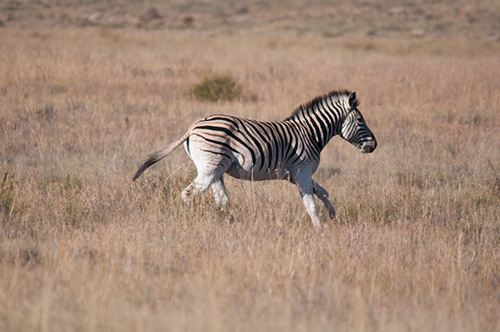
Young Mountain Zebra

Kudu

After tucking Elena in for the night, I went for a stroll to find the campsite's genet. Every South African National Park campsite must have one.


For our second full day we braved the Sonnenrust 4x4 loop, and were yet again rewarded with great plain's game, including Gemsbok and Eland. While Cheetah had been spotted on the Link road the previous day, we weren't so lucky.

Instead, we decided to chill out at the unused Picnic Spots. These are lovely, and both have swimming facilities. The first one also has a resident troop of cheeky Vervet Monkeys.

All in all, three nights was probably just right for a stay at Mountain Zebra National Park. Camping facilities were good, birdlife was great, and another day may have been fun to explore the other 4x4 trails, but we had our next park to get to. Below a small selection of some of the sightings.

Ground Squirrel

Gemsbok


Black-backed Jackal (number 7)

Both Burchell's Zebra (with the light brown intermediate stripes) and Mountain Zebra are found in the park


Mountain Zebra

White-browed Sparrow-weaver


Saturday, 2 March 2013

The Black Eagle has landed

This is a sequence of shots of a Verreaux's (Black) Eagle I was fortunate to view up close during yesterday's transect. He/she has been hanging around for a few days now. I'm always torn between wanting to not disturb these majestic creatures, and wanting to shout and chase them - to teach them to fear humans. Their ranges are large and easily extend beyond protected areas and over sheep and goat ranches nearby - where they are not viewed with a friendly eye, considered to be predators of lambs and kids. Sadly, a dollar is still worth more than exquisite beauty. Perhaps somewhat selfishly I left this regal bird unmolested.

To find out more about Black Eagle Research in South Africa, visit the Black Eagle Project blog... http://blackeagleproject.blogspot.com


4x4 rolls off a hill


About the most exciting event that occurred during the February survey was just after finishing a transect at Kouga Wilderness. I had arrived the previous day in order to camp and get to the transect start at a reasonable time – as this transect is the furthest from Blue Hill – over 130km away by road, 30km of which is down the scenically spectacular Kouga Canyon. In a straight line, Kouga Wilderness is only but only 50km from Blue Hill as the sunbird flies. The campsite is under old oak trees, and I was the only person there, until the following day when I was packing up and a young man in his early twenties dropped of his kit at a small caravan.

To do the survey I had taken my bike up a 4x4 track leading into the mountains. On the way out the owners, Nico and his wife, asked me why I had not driven up in the Jimney. While my reasons were many, I replied that at the moment my tyres were a bit worn and I was having them changed the following week.

Having just said that, we all fell silent as from the hills a thumping noise grabbed our attention. We looked around to see if something nearby was falling over, and then realised the noise was echoing down the valley. Then we saw from the 4x4 track that ascends the steep hill opposite a white bakkie (pickup) rolling down the hill.

“It's not that young lad, o gids, o yinna!” cried Nico's wife

Of course it could only be – there was no one else around. I was torn between starting to run towards the tumbling vehicle, or running for my camera. After an eternal three more seconds we heaved a collective sigh of relief as we saw the young lad (Hennie) running down the zig-zag 4x4 track. The 8 month old Toyota finally came to rest against a giant Aloe ferox.

After some time spent calming Hennie down, it transpired that on the ascent he had occurred a puncture. He had changed the flat tire, and as he was fastening the last wheel nut, the hand-brake gave way and the bakkie immediately obeyed the laws of gravity. He was of course very lucky not to get caught in the way of the run-away vehicle.

Nico's comment to Hennie: “You have the honour of being the first vehicle to roll of that 4x4 track”

Lesson learned for the day – always chock your tires with a rock when stopped on a steep slope!


A view of Kouga Wilderness and the the 4x4 track from which the bakkie rolled.


Counting birds out and about

This summer has been one best described as unpredictable. Temperatures have ranged from 12 degrees on some days, to 35 and over on others. One never knows what to expect, and planning ones day relies a lot on checking weather reports. Even those don’t always get it right. One day looked was forecast to be windy and good for nothing. On waking up too late to change plans the weather was perfect for ringing. Still, there are things to do on the laptop, and time has been spent creating the PhD version of my book and making changes to a manuscript on dietary patterns of parrots of the Peruvian Amazon.

 The nice thing about doing point transects to count birds now is a lot of the baseline data was already collected during the first round of transects, so they can now be done a lot more quickly without too much checking of the gps to make sure I’m walking in a straight line for far enough. So transects that were hard the first time, like going up Antoniesberg, heading over Naartjieskloofberg, and cycling up the Kammanassie were a bit easier this month. During thes hikes or ‘bhikes’ I continue to look for birds with rings, but resightings have been very few. So, late January I placed some camera traps on flowering Protea repens around Blue Hill to see if they would serve as extra ‘eyes’.

 The results have been encouraging. While there are many blank shots taken simply when the wind blows the Protea bushes, many photos have recorded birds, and a few of these have had rings. The problem is I don’t have enough cameras, and used most of my research budget this month to busy an additional 5 cameras – not cheap at close to R3000 each. But they are generating a wealth of data, especially the short video clips which show how the birds are foraging on the Proteas. They may well be useful yet in determining how the birds use the landscape.

Cape Sugarbird takes flight

Spurwing Goose take-off sequence

Cape Sugarbird on a Protea mundii, Prince Alfred's Pass

Rufous-breasted Sparrowhawk
Awesome colors of the Fynbos - Prince Alfred's Pass

 
Related Posts Plugin for WordPress, Blogger...