Monday, 15 May 2017

Break to Borneo

Its 6pm, the end of my first full day in the city of Bontang, East Kalimantan, Indonesia. The cicadas are battling to be heard over the mosque loudspeakers issuing the evening call-to-prayer. I'm on the edge of an 18-hole golf course fringed by mangroves. Looking beyond the mangroves is a wooden village on stilts in the water. Everything feels kind of surreal: it took 4 flights with over 17 hours flight time and a 6 hour taxi ride straight out of gran-turismo to get here, more than 36 hours travel time.

You know you're headed somewhere remote when the bookshops in the airports don't have a travel guide to where you are going. In transit through Singapore I found the first travel guide to Indonesia, as thick as my middle finger, and it had 2 pages on East Kalimantan on the island of Borneo. In Jakarta, I find one Lonely Planet guide to Indonesia: I buy that and a bird book. I'm the only muzungo / gringo on the plane for the last flight to Balikpapan.

So: Some fast facts about Indonesia: it is an archipelago of over 17 000 islands, the largest of which
are Sumatra, Java, Borneo, Sulawesi and Papua. Indonesia is the world's 4th most populous country with over 255 million people. The official language is Indonesian, although that is a second language to 80% of the population. Even at the pretty fancy 3 * hotel, the English of the staff is basic at best, although that is not a bad thing: watching the waitress do an impression of a cow to explain an item on the menu will go down as a highlight of the trip.

I was last in Borneo more than 20 years ago as a backpacker, and then only on the northern Malaysian side: Sabah and Sarawak. However, most of the island belongs to Indonesia.

The reason for my visit to this area is not for birding! It is to learn about an IUCN project that uses species traits to examine their vulnerability to climate change. But more about that later. The first few days when not on the laptop I've been out birding in this tropical environment as much as possible.

Birding Bontang, Borneo.

While some countries, like Peru, have bigger total species lists, Indonesia has the highest number of country specific endemics: 381 of 1605 (24%) species! Perhaps as to be expected with such huge human impact, about 20% are considered to be species of conservation concern according to Morten Strange's Birds of Indonesia (the only bird guide to the birds of the entire archipelago, but even so only with 912 of the total number of species).

Some important Borneo birding facts: there 52 endemic species of the 669 species that can be seen here. The best bird book is Phillips' field guide to the Bird of Borneo. An example is one of the quick id by habitat plates, which pretty much was a one stop id page for birding around the hotel.

I'd only find out later that there was a sign saying 'entry forbidden' – it was in Indonesian, so I spent several afternoons and a bit of a morning out trying to spot feathered creatures in the secondary forest and mangroves lining the golf course.

One day of the workshop included a day trip into the Kutai National Park. This park was declared by the Dutch in the 1930's and has been shrinking ever since: originally 3 million hectares, it is now less than 200 000ha. That is admittedly still pretty big, but the drive along the road that skirts the edge of the park revealed massive rural settlements and oil-palm plantations in the park. With open-cast coal mines to the north, and oil palm plantations to the south, the protected area is under massive pressure. Droughts associated with El Nino meant that almost the entire park burnt sometime in the 90s. Given all that it is practically a miracle that Orangutans are still found here. An estimated population of between 1500 – 2000 is found in the park. It is one of the best places to see wild Orangutan in Indonesia, although certainly also one of the least straightforward to access, unless you come with your own car and a lot of preparatory work.

As promised though, after a couple of warm up walks through the forest, and a typically amazing Indonesia buffet that included things like Snake fruit, battered shrimps, we were rewarded with views of the arm of a large male Orangutan reaching for figs in a tree on the side of the river. Later, after another walk we had spectacular views of a female feeding very close to the staff accommodation of the rest camp / ranger post. Our group of researchers weren't the only ones to get great views, a local news documentary crew were also on-site.

Although a bit late in the day for birding, certainly the highlight of the walk through the forest with local guide Harya was the Greater Slaty Woodpecker, a Bornean endemic and also the largest woodpecker in the world! The photos are more personal glory shots than images that capture the beauty of the bird.

So what was the workshop all about? Anne Russon does research on Orangutans from the perspective of the development of intelligence. Of course she is also very concerned about them on an individual level, since these magnificent red-haired cousins of ours continue to be poached, with youngsters sold for the pet trade. The large number of rehabilitation and reintroduction projects across Borneo attest to conservation efforts aiming to deal with this. However, the threat of deforestation and fires (predicted to increase under some climate change scenarios) is a real concern, and so Jamie Carr, Climate Change Programme Officer of the IUCN Global Species Programme had organised this workshop to do a life history trait based assessment to climate change vulnerability. What is going to come of that.... you'll have to wait and find out!

In the meantime, enjoy some of the scenes from Borneo, and visit the forest while you can, as it is disappearing incredibly fast, as are the animals that rely upon it.


These photos in high res plus More photos:


Tuesday, 25 April 2017

Of starry Karoo nights and friendly sheep


An early start to the week was hampered somewhat by a car battery made lazy by the cold weather, but luckily that fail was in reach of a charger with extension. My target for the week was to survey three pentads for the Karoo BioGaps project around Beaufort West. The first pentad was close to the area currently targeted for Uranium mining, a farm managed by Buyisile and partners. They run Angora goats for their wool.

After navigating the labyrinth of unmarked dirt roads behind the dusty town of Rietbron, I made it to Tulpleegte. Buyisile made me welcome with a cup of tea, and allowed me to set up camp in an unused shearing shed on the property, as the wind-chill factor was running temperatures down into the blue end of the colour spectrum. The farm had had good rains earlier in the month: the first in over a year. Buyisile told me that the rain had been a make or break moment for them, as the goats had started dying. Now, 10 days or so after the rain the grey bushes were hinting at the green within. I'd spent some time watching tortoises in the mud a bit earlier, and commented on this to Buyusili, who said “Yes, there are so many tortoises sometimes I think this is a tortoise farm and not a goat farm!”

The afternoon survey turned up the usual suspects for a Karoo flat-lands survey, plus some nice sightings of Double-banded Courser. The last survey was near the shed, where a shallow dam added a bit of depth to the birdlist.

After setting up my tent in the shed, displacing a small flock of House Sparrows in the process (sorry okes!) I was able to spend some time enjoying the sunset, serenaded by distant jackals. This gradually gave way to reveal the depths of the universe above. It had been some time since I'd done some star photography, and here is a choice of my favourite pics (all captured with a macro lens made for photographing bugs no less!).

Windmills and Stars, with the glow of Beaufort West in the background

Windmill and Taurus

20 second timelapse of an aeroplane traversing the sky, traversed by satellite trails

Acacia with a starry sunset

A sisal reflection in the dam

Pale-chanting goshawk stares up at the star spangled sky


With the thermometer struggling to reach double digits the Wednesday morning, and with some concern about the battery, it made sense to do the first surveys by bicycle. Bird of the morning would have to be a pair of Secretarybirds, warming themselves on top of their Acacia tree roost.

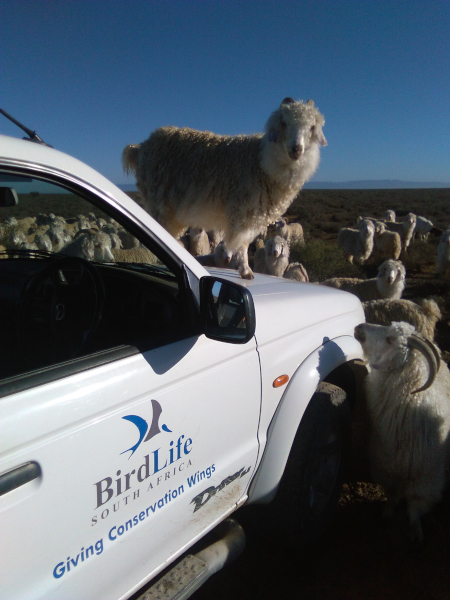
20 point counts for a day, separated 1km apart, puts one on a tight schedule, so once temperatures were up it was back to the old Mazda Drifter to cover a bit of distance across the pentad. Great views of Greater Kestrel were followed by one of the surveys most memorable moments: coming into camp with a herd of Angora goats, upon spotting me they came running towards me. They then proceeded to climb onto and into the bakkie! Some of the more cheeky ones even started nibbling my clothes to see if I was edible! This would have been a great script for a comedy-horror movie. Eventually, realising I was not about to feed them or give them a shampoo (yes, Buyisile does this) coupled with fact I tasted terrible, they wondered grumpily on.


Help! I'm being hijacked by a sheep!


Are these the Tulps of Tulpleegte?


Wrapping up the morning surveys it was on to Beaufort West, for a rendezvous with atlasing addict Stefan Theron. Stefan works for 'landbou' but is a real expert on Karoo birds, having at one time held the record for the most birds in a pentad in the Western Cape. He provided a bunch of hints, tips and insights, and put me in touch with the farmer who owns most of the land for the next pentad I had to survey. As this is bisected by the N1 and public dirt road, I'd been just planning on using those for the survey. I'd later be very grateful for the contact as I'd underestimated the truck noise on the N1, which made the first counts along that route an absolute pain. But that was for the following morning: the afternoon was spent surveying the quiet, southern Hopewell road. While by this time very hot, it was an unforgettable section of road that I will forever remember as Bat-eared Fox alley. At almost every point somewhere in the distance I'd pick up one of these exquisitely cute little foxes X-raying the ground for insects with their enormous ears. They certainly outscored the Aardwolf sighting along that route.

I overnighted peacefully in the Karoo National Park at the campsite arriving late and leaving early, so with nothing to report for the park itself, as I had to hit the northern side of the pentad at sunrise. The quiet of the park contrasted enormously with the roar of the N1: the highway that never sleeps. Luckily for me Ian Murray, the farm owner was around. He very kindly allowed me access to the farm, and also provided one of his farm-hands (Marius) to act as guide and gate opener. Once onto the farm it became clear the rains that had fallen to the south had not made it here, apparently no rains >10mm have fallen here in 2 years. To record anything during counts I had to scan the far distance for Karoo Chats and other perching insectivores.

While the species tally for the pentad would prove to be lower than the 34 of the previous pentad, there was one birding highlight: while approaching one point count location which coincided with a reservoir, a pair of brown, chirping brown things approaching proved not to be Lark-like Buntings, but Sclater's Larks. This is an unmistakeable little lark with a tear-drop marking below the eye, but also one that is incredibly scarcely reported. The birder/photographer will ever begrudge the scientist needing to take distance and behaviour data, because by the time that was done the birds had finished drinking and flying off to be engulfed by the vastness of the Karoo.

Wrapping things up, and with a new battery providing a bit more confidence in the Drifter bakkie, it was off to Klein Waterval. This farm, in the shadow of the Swartberg mountains had just been purchased by Adriaan Nortjie of Caroluspoort Game Farm, and they were waiting for me. Armed with gate key, a cup of coffee and chilli-biltong, all kindly provided by Adriaan, it was into the rough and hilly terrain of Klein Waterval. The terrain was in stark contrast to the flat and almost featureless pentads of the previous days. By the following day I had to count it as a minor miracle that the sharp shale rock and spear-like Acacia thorns had not resulted in a puncture.

For the evening I'd booked into the Groot Waterval guest farm not too far away (although a glance the wrong way at the wrong time meant missing the sign and getting lost, negatting that particular benefit). Now, if you are considering a Karoo holiday I have to strongly recommend Groot Waterval, not too far from Prince Albert. The hospitality was exceptional: I was invited to have dinner with Danie and Narina Le Grange and their son Terblanche; after which I felt like part of the family. You can find them here: http://www.grootwaterval.co.za/.

Friday morning was the wrapping up of the Klein Waterval pentad. Despite also having received the good rains (that washed away the Swartberg Pass just past Prince Albert), I was surprised again by the low species count, this time the lowest of the three pentads for the week at 29. By contrast, surveys in the pentads from March had provided species lists generally over 60 species. In general, granivores were scarce, with another bird noteable by its absence being the Lark-like Bunting. Here, perhaps due to poor summer rains, there was an almost complete absence of grass across the pentads, which might partially explain this. So: its not only if you get the rain, but also when you get it, that appears to be important for determining species richness in the Karoo. It is also clear that in order to maintain the unique species community, that vast areas will need to be maintained in near-natural state in order to provide the resources to those species that have to track resources in space and time.

Again, thanks to Buyusili de Bruyn, Stefan Theron, Ian Murray, Adriaan and Janien Nortjie and the Le Grange family for another memorable week of Karoo Birds Surveys.

And lets wrap it up with some bird shots...

Greater Kestrel

Double-banded Courser

Karoo Chat

Karoo Chat with grasshopper lunch

Karoo Chat (you should know that by now)

Bat-eared Fox

Only possible selfie of the sections surveyed by bike...

The Drifter adrift in the Karoo


Tuesday, 28 March 2017

Karoo Surveys part 2: Karoo National Park and Victoria West area


Tuesday evening, Victoria West: isolated thunderstorms march across the plains of the Karoo. Strong winds kick up dust everywhere. In the late afternoon, I had to abandon an extended count associated with the local dam in fear of a drenching. But the walls of rain are picky in where they choose to fall, and the afternoon was spent mostly in anticipation of what the dark skies would unleash. Visions of a flooded campsite and rescuing the contents of my tent did not materialise.


The week had started well though. For my birthday I’d booked a family cottage in Karoo National Park for the Saturday night to lure Anja away from Uniondale. The rest camp was used mostly just for exactly that – resting during the hot, dry afternoon. Sunday morning I snuck in the first point counts during a drive up the Klipspringer pass, while Anja enjoyed watching the Black Eagles launching themselves off of the edge of the canyon, swooping below us and down the valley, to return within minutes out of nowhere with a new stick for their nest. Right now this must be the most epic place to watch these birds in action.


It appears that it has been some time since a good rainfall has blessed the park. Despite the dry and dusty feel, bird life was good. The bird hide revealed a Little Bittern (or the eye at least), as well as several wildlife encounters: notably a Grey Mongoose sussing out a resting Hadeda. Little Swifts filled the air in their hurry to go nowhere particular, a task achieved a lot more sedately by the camps many giant Leopard Tortoises.

This is what must pass as a mermaid in the Karoo

With the family back on their way to civilization (as I know it), I started counting in earnest. With temperatures below 30 degrees, coupled with overcast skies, conditions were pleasant, and birds were active: each point taking an age to complete. There is plentiful tolerant wildlife in the park, which also provided many distractions between points. How can one ignore so many picture perfect occasions?


Monday morning and the counting continued on the escarpment plateau, where Sickle-winged Chats are at their most common. At 10.30 am the gravel plains were starting to get a bit reticent about revealing their occupants and I headed for the Bulkraal picnic spot. Here a pump and regular watering of the lawns mean a lot of semi-habituated birds, although the resident Namaqua Warblers proved too elusive for the lens. A particularly exciting rarity encountered there was a Faansie Peacock, author of Chamberlain’s LBJs and Waders books, and a species which can be accurately identified from the photograph on the back of the Wader’s book.

Familiar Chat

Sickle-winged Chat. These 2 will take up ours of my life trying to separate in the field.


Further distractions from my make-shift office under the Acacia trees included a curious Vervet Monkey, which forced me to temporarily abandon work as it perched in the branches above my laptop, forcing an evacuation due to fear of a drenching in monkey pee. Then it was bye-bye park as I headed to Molteno Pass, which forms the eastern boundary of the pentad I was surveying. By 6pm the survey line was complete and it was the 120km drive to Victoria West, the small Karoo town that services the N12 highway traffic to Kimberley.


It had been 6 years since I’d last passed that way, and I was pleased to see the Lesser Kestrels are still around (reading my last post on the visit, I really had been wondering). The Paradise campsite, where I’d stayed before, was still open and I pulled in to set up my tent for the week. Passing rain showers during the evening had me worried, but proved harmless.

Then it was yet another early morning start for more bird counting. This is Lark land to be sure, with Clapper, Thick-billed, Long-billed, Karoo and Spike-heeled all on the lists within a couple of hours. A point falling at the edge of a farmstead kept me busy for over half an hour with a prolific number of birds, including a flock of 48 Speckled Pigeon drinking from a water source. But as the morning advanced, so did the wind speed. It was clear another session would be needed in order to thoroughly survey this important pentad: one of the few Karoo pentads that has more than 10 lists for the SABAP2 project, and so a vital one for trying to understand the link between bird densities and reporting rates. But as you’ve read, the afternoon weather was not so accommodating.

Wednesday morning was better, and I chose a route that would keep my back to the sun for a bit of illustrative photography. The first curious encounter of the day was watching Lesser Kestrels eating pebbles from the road. Later on I'd watch Cape Wagtail, Three-banded Plover and Shelducks harassing a monitor lizard.


The New, Improved Lesser Kestrel: Version 2.0!


The afternoon would be my first surveys for the Biesiebult pentad. The farm owners, JR and Sandra, were well accustomed to the BioGaps research crews passing through, and were very welcoming and interested in the project. It is a sign of the size of the farms in the Karoo when the ‘driveway’ is 6km long! The farmhouse is completely off-grid, with solar panel arrays and giant Aga stove for keeping warm during winter.  While the dominant biomass in terms of birds were definitely farmyard geese (the down used for duvets), the local dam added most of the species richness to the atlas card. The rest of the farm is ‘egte plateland’ or Karoo as you’d imagine it. Still, Blue Cranes with chicks were scattered across the landscape, while further birding highlights included Secretarybird and Grey winged Francolin.

However, the main highlight was really just talking to the landowners and getting an insight into life off-grid in the Karoo and their relationship with nature. During winter, they need to put large pots of water on their wood stove, as pipes can stay frozen until 10 in the morning. And rain is always a topic of conversation. “Ons kyk vir die natuur: ons sien die miere werk, die voel bou nessies, die slange loop, dan weet ons dit gaan reen.” <We watch nature, we see the birds and ants begin to work, and the snakes becoming active, then we know it will rain>. Here for the first time I also realised that the large satellite project, SKA, was becoming an increasing annoyance to the people who live in its shadow… but more about that later.

Thursday saw me wrap up surveys on the farm, before heading to what I thought would be my next survey pentad. Unfortunately, as it is one of the ‘additional’ pentads of the BioGaps project, there had been no ground work yet, and the contact information associated with it was irrelevant. The day became a quest for access to the seemingly inaccessible pentad, made all the more difficult by a lack of cell phone reception in the landscape. However, it culminated in one of the most interesting and useful meetings of the day; one that would impress upon me my full naivety of what is going on in the Karoo.

By 5pm I’d all but given up, when I came upon another dusty road that headed in the right direction. A chance encounter earlier in the day had clued me in to the fact that a local farmers meeting was happening, so when I passed a farm with many white bakkies pulled up around it, I suspected it was a place I needed to be. After explaining my goal to farm owner Mr Hugo, I was invited in. As part of my life at Blue Hill, I attend the local farmer meetings from time to time, so the setting was familiar. Talks and conversations were about sheep, wool prices and the threat of ‘blue tongue’ sickness. But this was a meeting with a difference.

The final speaker at the group was the extraordinary Bonnie Schumann, field officer for the Endangered Wildlife Trust’s ‘Drylands Conservation Programme’. Bonnie is working closely with the farmers in the area, using the endangered Riverine Rabbit as the flagship species. Many of the farmers are part of the national conservancy program. Bonnie was an absolute goldmine of information on everything from fracking, to the impacts on people living in the Karoo of the SKA program, and perhaps most importantly for me: Uranium mining. While most of us have been aware of fracking, the threat to livelihoods and the environment posed by uranium mining have largely escaped media attention, and scale of this threat is truly, truly alarming. Read this very level-headed analysis of the problem hosted on karoospace to find out more.

For me, Bonnie’s talk before I had my 5 minutes was also very useful: one has to be very wary if one wants to be useful in effective conservation to avoid the ‘Groener’ label (Bunny-hugger), and it was great to see (ironically) Bonnie’s work with the Riverine Rabbit so well received by this farming community. I was thus a bit more confident about introducing myself and my work; and all the necessary farmers came forward to introduce themselves to me afterwards. Furthermore, I was invited to take part in dinner. There is a saying “You know you are in the Karoo when there is more meat on your plate than veggies” and that was so totally true: this was Karoo hospitality at its best.

With the diverted Thursday afternoon, it was clear to me I would not be able to undertake an effective survey of the target pentad on the Friday, faced with having to pack up my camp in Victoria West and the 5 hour journey home. I chose instead to consolidate contacts made the previous evening: I’d been especially captivated by a tale by one of the landowners of ‘living fossils’ in the high altitude pans on top of the mountains where he lived. The possibility of Drakensberg Rockjumper too sealed my interest and Abramskraal was my destination for the day.

Okkie Wiehahn and family were extraordinarily welcoming and hospitable, insisting I join them for home-baked lasagne. I’m very quickly starting to believe the Karoo is filled with the nicest people on the planet! It was interesting to hear Okkie’s concern about the growing number of Pied Crows (heard a number of times during the week), and particularly their impact on the small tortoises. Again, distances and time got the better of me, and it was clear an expedition to the escarpment would be beyond what the day would be able to handle: It’s been added to the growing list of things to do.

So, overall: while perhaps lower on point counts than desired, from an educational perspective, this was a very important week for me as I begin to unravel the issues at stake for landowners and the birds of the Karoo.

And we'll wrap it all up with a few more bird shots from the survey:

Karoo Long-billed Lark

Ant-eating Chat

A bird with 'nice personality'

Layard's Titbabbler

Lesser Swamp Warbler

Brandewyn drinking bulbul

The eye of a the Little Bittern

Rufous-eared Warbler

Damn, I hope that is a Karoo Lark

Life is good in the Karoo, even for porcupines.


Related Posts Plugin for WordPress, Blogger...