Friday, 18 September 2015

Exciting Resighting: Female or Male?

I posed the question above to the Western Cape Birding Forum last weekend for the following photo of a Cape Rockjumper:


Except it was a trick question. The bird is in fact an immature bird ringed in 2013 during our first round of Cape Rockjumper captures. At the time I registered the bird as a youngster based on the brown, not red, iris, buff wing spots and residual gape. But I also called it a possible female and duly gave the bird a one colour identification ring.

This past season Gavin Emmons was helping Krista Oswald catch more Cape Rockjumpers. He took the following photos of a splendid male – with yellow ring. Thanks to the colour band we know he is the same bird from 2013! Very exciting to get this resighting :)


Centre of attention: here fellow family members direct their calls to male yellow. Photo courtesy of Gavin Emmons.


Below is a photo of a juvenile Cape Rockjumper, probably only 1-3 months old, from the Swartberg Mountain range.

Note the black, not red, iris


And this is how they start off life. Sad thing though: >60% of nests fail; which is pretty much the norm for ground nesting birds. 


Thursday, 17 September 2015

Radical Raptors revisited: the flight of the drone

Radical Raptors remains one of my top recommendations for visitors to the Garden Route. The personal touch, strong conservation and education messages and quality of the performance make the raptor flight shows a real winner. After my first experience I was very keen to bring the family along.

The first owl we were introduced to was Charlie the Spotted Eagle Owl. Our Charlie was rather impressed with the feathered version. Eli preferred Barney the Barn Owl. For me the highlight was a new addition to the show: the Harris Hawk demonstrating its aerial attacking ability on a drone.


Despite a very windy morning, which can impact bird flight behaviour, we had a thoroughly enjoyable show. It is also very nice to know that the entrance fee supports raptor rehabilitation: so please do support Dennis and his extended feathered family if you get a chance to do so. Raptors are a group of birds doing particularly poorly in our rapidly changing world, due to poisoning and persecution and every cent helps.


You don't want to be a mouse at Radical Raptors... 


Harris Hawk attack on a model bird supported from a hover drone


Birds of Eden


The Garden Route of South Africa in the region of Plettenberg Bay hosts a vast range of entertainment attractions to satisfy every whim of the diverse range of tourists that visit the coastal region. One of which I have been interested in visiting for a long time is Birds of Eden, an immense walk in aviary boasting 200 species with thousands of individual birds.

With a few days off I decided to treat the family (or myself?) to an afternoon here. Treat being the word – because with an entrance fee of R175 per adult, this is a fair whack of money for most South Africans. There are combo tickets available should one also wish to visit MonkeyLand next door (R280 for entrance to both), but since we’d been chasing hungry Vervet monkeys from our doorstep in the morning, Monkeyland just wasn’t on our wishlist.

The aviary has a very long walkway that winds through forest, with a gushing stream in the valley below. The roof is very high overhead, with plenty of flight space for the birds: staring up I felt as though I was in the fighting arena from the Hunger Games movies: just no Mocking Jays to be seen.

Food tables with very tolerant birds line the route. The bird diversity is represented by birds from all over the world, so Cape Weaver and Red-eyed Doves from Africa (probably among the most common birds) feed alongside Blue-and-Yellow Macaws and Red-faced Parakeets from South America. Spectacular Golden Pheasants fed below our feet while a variety of Turacos bounced among the branches above us.

Despite it being mid-afternoon bird activity was plentiful. The attention we could pay to the birds was frequently compromised by our kids getting sometimes a bit over-excited by the proximity of some of the more tolerant birds; but also unfortunately by wheelbarrows ferrying sand along for some construction project. The calls of birds in some places were indiscernible above the sound of compressors and machinery. Very, very annoying since we felt compelled to hurry through several hundred meters of walkway.

The highlight of the trip was Elena being courted by a Burrowing Parrot, who followed her on foot for a good section, and dropped flowers at her feet. The parrot also put in a good effort chasing off Charlie when he got too close.

Overall, if I had to give a score out of 5 it would be 2. While I’m not excited about animals in captivity, I’m not against them either if there is a strong educational and conservation motive. This is lacking at Birds of Eden, where the motivation is clearly financially driven and there is ample room for improvement. The Eden district of South Africa is home to 8 species of birds endemic to South Africa: 7 endemic to the Fynbos, and 1 to the Forest (the Knysna Warbler); yet there is no mention of these anywhere. There are also several impressive bird research and conservation projects being undertaken in the region through Mark Brown and the Nature's Valley Trust; but how or if any of these are benefiting from the Birds of Eden cash cow is not clear. 

I'm afraid to say I won't be back anytime soon. 

There are several green Turaco species in the aviary.

One of the World's most spectacular birds: Golden Pheasant (male)

Busy bird feeders with a good choice of food

Deja Vu: this photo could easily have come from my study sites in the Tambopata

White-faced Ducks and many other species look like they are at home

Scarlet Ibis is always a winner

Typical scenes from the long board walk through the aviary.

Fulvous ducks didn't get the thumbs up from the kids...
... not when your boyfriend is a Burrowing Parrot that gives you flowers!


Saturday, 29 August 2015

African Wildcat kills all our chickens

Monday, 24 August 2015

The day started with thunder in the distance, an omen for events that would unfurl that day. I set up nets for the mornings bird capture session as lightning played on the hills to the south. It is August, still winter, but minimum temperature for the day would be 17 degrees – sometimes the maximum for a warm day. Eventually the berg winds bringing hot, compressed air from the arid interior dispersed the storm clouds. I'd caught a Cape Rockjumper and needed to head home.

Scanning the day's headlines I noticed ISIS had blown up another historic memorial; refugees were storming Europe; people were committing suicide due to the Ashley Madison data leak; and stock markets were plummeting. Echoes of a world on the brink.

On attempting to settle down to write the conservation assessment for Cape Rockjumpers, I heard Elena's shouts from the chicken coop. Heading to the kitchen window I saw Elena and Anja running back to the house.

“There's a wildcat in the chicken coop; all the chickens are dead!” was the news.

The wildcat had apparently climbed up some shade cloth we had over the main window of the coop and squeezed in through a narrow gap. The smooth window on the inside prevented it from escaping. It was very thin, with a lame back left leg. Clearly a desperate individual. During its time in the coop it had killed our four chickens and the rooster.


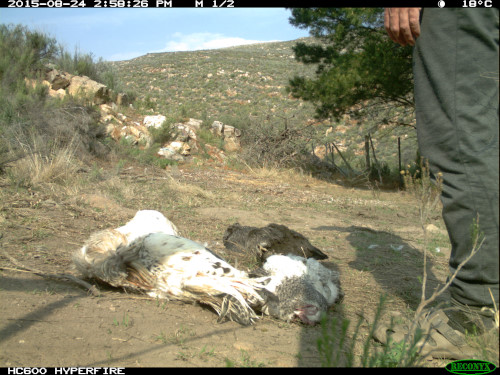
After the volunteers and researchers had had a look we opened the door and let it go. We placed the dead chickens near a camera trap to see if the cat or any other wildlife would return to feed.

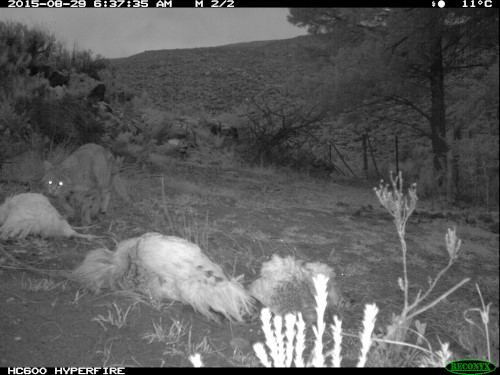
These are the results after 5 nights.

The dead chickens laid out at the camera trap

A common duiker is the first to pass the scene

Then a Cape Grey Mongoose (look left)...

The mongoose drags the dark chicken away to the cover of bushes

A Hare passes by during the night

Then there is no activity for 3 nights until the return of the African Wildcat

The wildcat simply smells the chickens, perhaps too ripe by now, and moves on

The next day there is no evidence the wildcat has been feeding on the chickens, a common Duiker passes by


We will miss the fresh eggs from our free range chickens, but events like this are part of life if living on a nature reserve: we cannot complain.

Saturday, 8 August 2015

Rockjumper Peace

While the rest of the team was out today catching more rockjumpers, I was keen to follow up on the male released that was featured in the WAR post. On approaching his territory, I encountered an unringed male in the no-mans land between two territories. Not long after entering blueblackorange territory, I heard an alarm and caught sight of the familiar gliding form down the hill. I had the camera at the ready, and snapped some pics. Very exciting to see that it was blueblackorange and even more exciting to see that he was carrying a beak full of nesting material!

As an aside, did you know this antelope is a Klipspringer, and that means rock jumper in Afrikaans.


Male Cape Rockjumper Blue Black Orange with a beak full of nesting material

Related Posts Plugin for WordPress, Blogger...